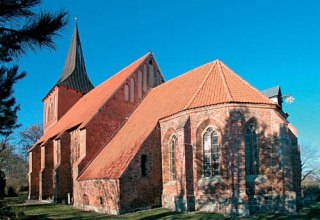
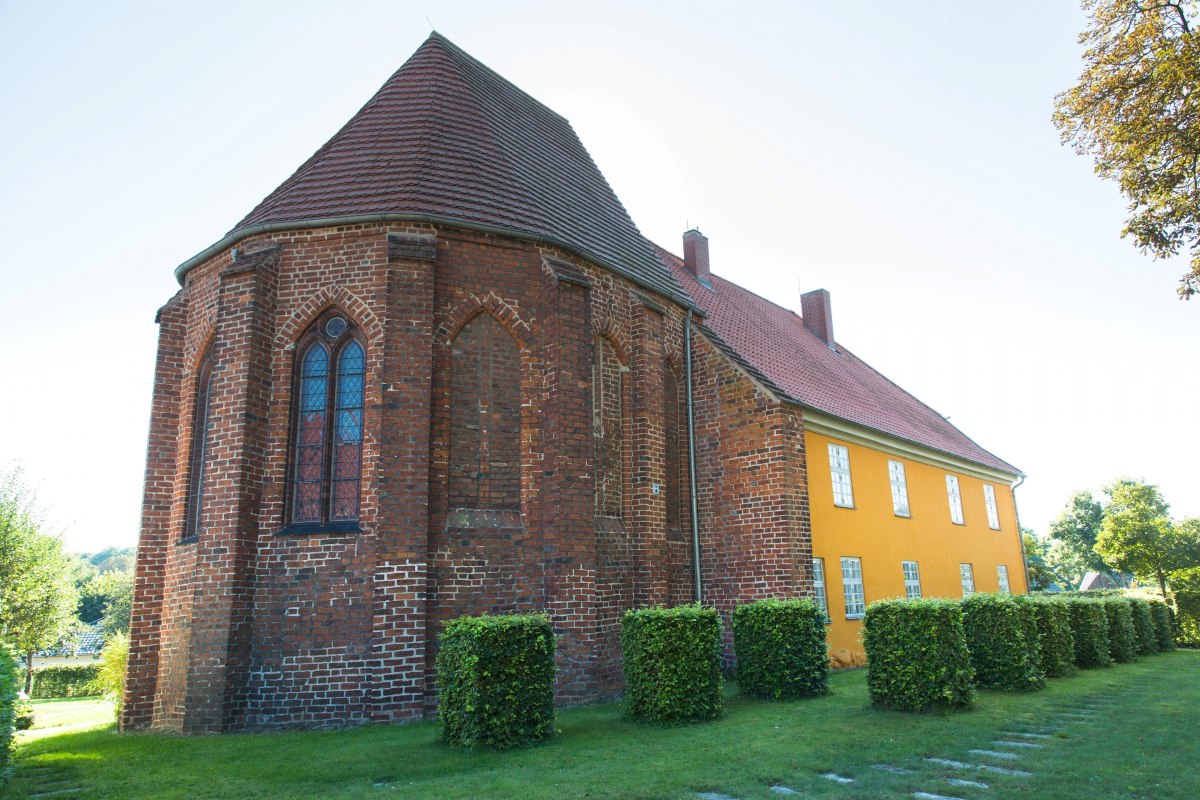
A former hospital chapel with hidden 15th-century murals that were not rediscovered until 2002. A 14th-century Gothic brick choir, first mentioned in a document in 1322. Once an infirmary outside the city gates, it is now a Bible center featuring restored 15th-century murals.
St. Jürgen Chapel stands in front of the former city gates of Barth. It was first mentioned in a document in 1322. The associated St. Jürgen Hospital served for centuries as a leprosarium and plague hospital, far enough from the town to prevent infection, yet close enough to provide care and pastoral support.
Of the original chapel, only the choir remains today. It dates from the 14th century, has a two-bay layout, and features a 5/10 apse—a typical form of Brick Gothic architecture in the southern Baltic Sea region. The former nave, presumably three-bay, survives only as its exterior walls down to the sill level of the present-day windows. Over time, it was repurposed and structurally altered on several occasions.
In 1818, a two-story, stuccoed central-aisle building with five bays and a gabled roof was constructed using the preserved nave walls. The medieval structure remained hidden within it.
Inside the choir, a surprise came to light during restoration work in the summer of 2002. Beneath later layers of plaster, wall paintings from the time of the church’s construction in the 15th century were discovered, including a depiction of St. Christopher. The figures were uncovered and restored.
Today, St. Jürgen is used as a Bible center. Exhibitions, events, and guided tours—primarily for school groups—explore biblical themes. The choir itself continues to serve as a place of worship, nearly seven hundred years after its construction.
Since 2024, St. Jürgen Chapel has been recognized as part of European Brick Gothic architecture.