For the fall exhibition in 2026, Klaus-J. Albert (born 1943), a sculptor living in Lübstorf, was invited to participate alongside the painter Walter Kröhnke (1903–missing since 1944).
After studying under Karl Hofer, Walter Kröhnke—who became acquainted with the French avant-garde during trips to southern France and Paris—very quickly developed a highly personal visual language. His work is characterized by an almost cool, subdued color palette, with sensitive, nuanced shades of gray and brown predominating, which always appear clear and fresh. He often structures his landscape and figurative compositions using undulating lines of different colors. He drew inspiration for his drawings and paintings from landscapes he experienced firsthand.
“In our time, one rarely encounters an artist who has developed such clarity and such order in his work as Walter Kröhnke … What is so appealing here is the inner harmony, the confidence with which natural forms are transformed into artistic forms.”(Doris Schmidt in the FAZ, 1946)
Following his first solo exhibition in 1936 at the f & f Gallery on Kurfürstendamm—which sparked fierce outrage among party members loyal to the party line—it became very clear that this art was unwelcome and that he could only continue to paint in secret. In 1943, his studio also fell victim to the bombs, and with it, approximately 200 paintings were destroyed. A few works were saved by being moved to a safe location and are now on view in the planned exhibition.
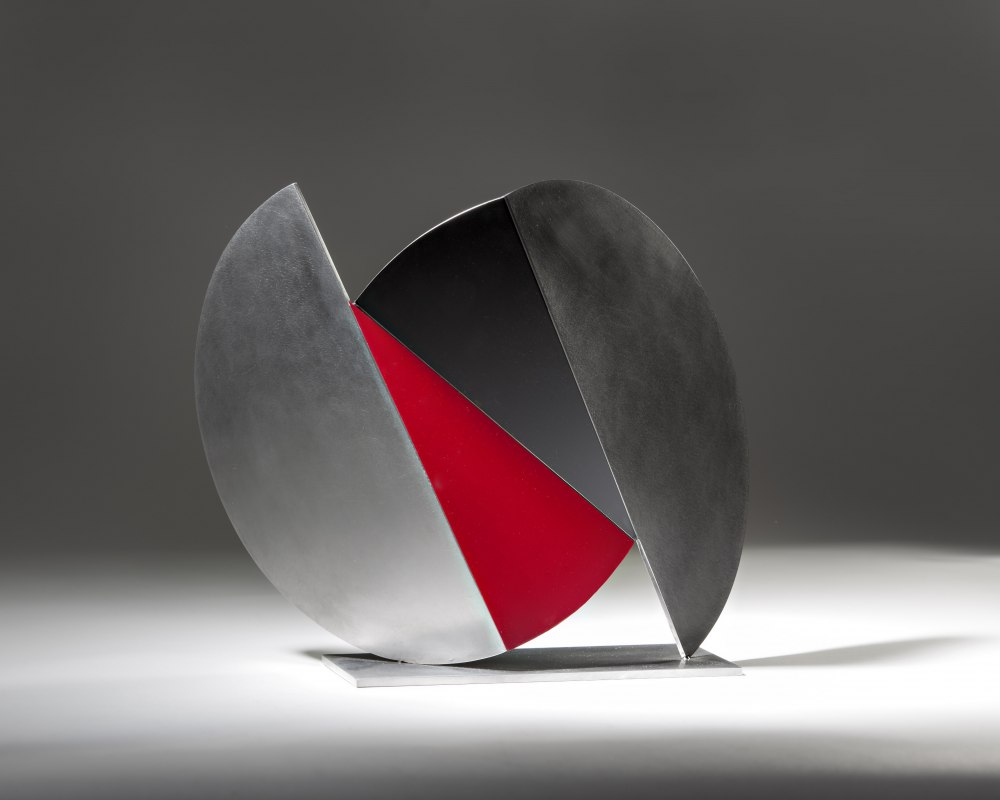
It was precisely the gently undulating structure of Walter Kröhnke’s works that inspired us to invite the metal artist Klaus J. Albert to participate in the exhibition with his small steel sculptures as a fitting counterpart.
Albert develops his sculptures through folding, thereby creating—in a seemingly simple way—a multitude of spatial design possibilities. Occasionally, individual surfaces of a steel sculpture are painted in color, which adds to their appeal. Spirals, curves, and arches serve as means of expression for highly imaginative, concrete, three-dimensional forms.
“The fundamental message of his extensive body of work lies in the experience of this elemental potential for tension arising from the form itself. Albert seeks to reach the viewer emotionally, using the visual experience to inspire the viewer’s own unique, further-reaching associations and thoughts.” Through his extensive artistic body of work, he impressively demonstrates “that the time-honored art of metalwork can provide valuable and indispensable inspiration to contemporary art when it manifests itself as an expression of strong artistic values and ideals deeply rooted in the artist’s personality.” (Hans-Peter Jakobson)
Hamburg-based art historian Dr. Gabriele Himmelmann will provide an introduction to the works of the two artists, and percussionist Walter Martinez will provide musical accompaniment for the opening.