
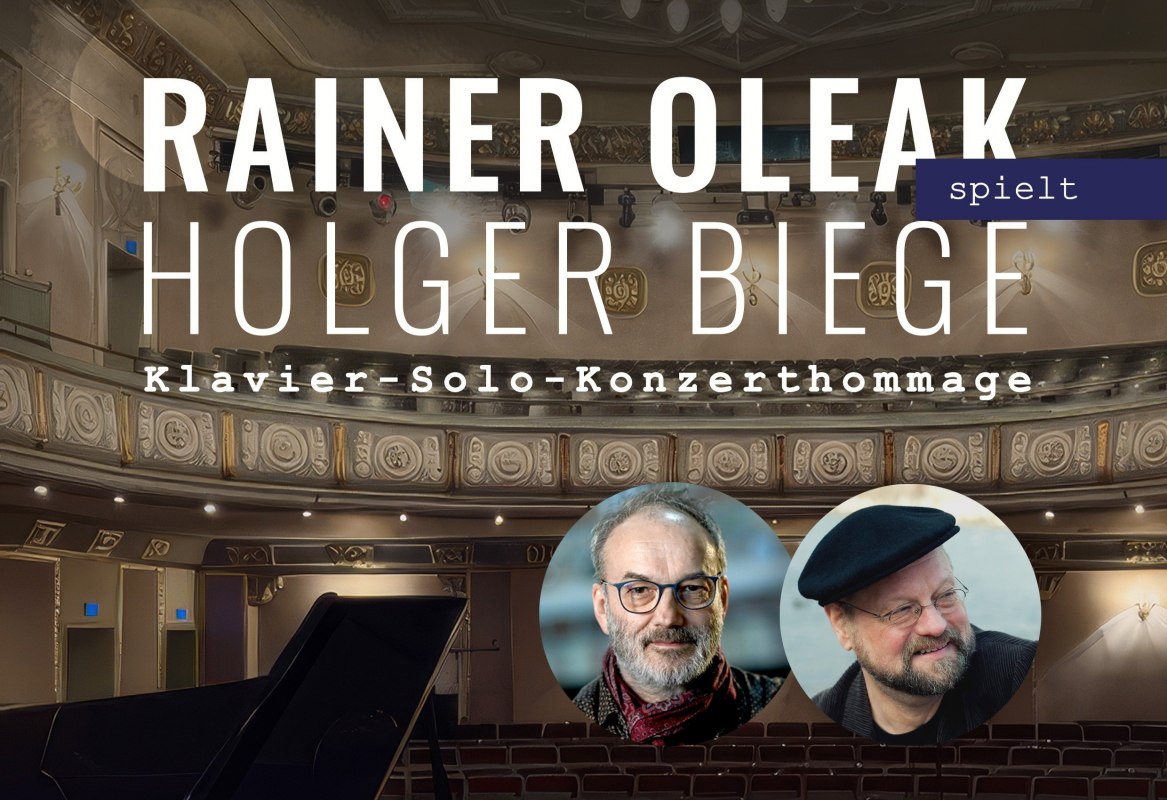
Holger Biege's greatest vocal classics in a sensitive and atmospheric piano concert.
There are encounters in the lives of two people that are so formative and lasting—or, as we say today, “profound”—for their future paths. One often reads about such encounters in the biographies of artists, especially musicians. The first encounter between the two musicians, Rainer Oleak (born in 1953) and Holger Biege (born in 1952), also turned out to be one of those “lasting” encounters—even though neither of them initially recognized it as such.
This was in 1977–78, when Holger Biege was recording his own songs for his first album, *Wenn der Abend kommt* (*When Evening Comes*), some at the radio studios on Nalepastraße in East Berlin and others at the AMIGA Studio on Brunnenstraße. Holger hired the Berlin jazz-rock band NEUE GENERATION to accompany him on these studio recordings; the band included some of the best musicians in the genre in the GDR at the time.
Holger Biege, the gifted singer, pianist, composer, and arranger, was convinced that this band would follow his musical vision and together achieve the best possible result—which is exactly what happened. “Wenn der Abend kommt” became an instant hit on the radio and catapulted Holger Biege, with his debut LP of the same name, to the forefront of public and media attention.
At that time, after completing his studies in “Measurement Technology and Room Acoustics” at the Technical University of Dresden, Rainer Oleak joined this very band, NEUE GENERATION, as a keyboardist. During the Biege production, he served more as a silent listener and observer, since Holger recorded his piano parts on his own. One memory that stands out is from the fall of 1978, when Holger Biege was recording the master tapes for two songs in Hall 2 of the East Berlin Radio Studios that he had composed for his brother Gerd Christian, including his superhit “Sag Ihr auch,” which became the “Hit of the Year” in the GDR in 1979. Suddenly, Holger asked for the lyrics and, without warning, sang over the backing tracks himself, “…so my brother knows how I envision it…”.
Everyone in the studio, including Rainer Oleak, got goosebumps, “...because Holger infused the song with such indescribable emotion...”—and that’s exactly what Oleak is now trying to achieve with his version.
Through all of this, he learned a great deal back then about Holger’s working style and the high standards he set for himself and the entire team. This impressed Rainer Oleak, who, like Holger Biege, had received piano training from early childhood and was pursuing his goal of becoming a professional musician.
His studies at the Technical University of Dresden later proved particularly helpful for his creative work as a producer in his own recording studio. First, however, he completed a degree at the renowned Hanns Eisler Academy of Music in Berlin, majoring in piano, composition, and music theory.
There are other similarities between these two highly talented musicians:
their fathers were scientists—Holger’s father worked in various scientific disciplines, including at the Academy of Sciences in East Berlin, while Rainer’s father was the well-known astrophysicist Hans Oleak. Much of this influence rubbed off on their sons, even though they pursued different career paths.
For a time, Holger pursued astronomy as a hobby on par with music. Rainer “Ole” Oleak became one of the most versatile and sought-after musicians in the GDR, with his own bands: after NEUEN GENERATION, first together with former KARAT singer Neumi Neumann in NEUMIS ROCK CIRKUS, and later with the band DATZU.
At the same time, he began his work as a composer for over 1,500 film and television soundtracks, as well as for numerous projects with fellow musicians such as Reinhard Lakomy, Frank Schöbel, the PUHDYS, Manfred Krug, Armin Müller-Stahl, and, after German reunification, with international artists, including Ute Lemper and Tony Carey.
He also composed the music for figure skater Katarina Witt’s free skate routine at her final Olympics.
At his home in Dahlwitz-Hoppegarten (near Berlin), he built his own recording studio, the “Tonscheune Oleak.” It was there that the CD “Rainer Oleak Plays Holger Biege” was recorded; the concept for this project was presented to Rainer Oleak by the KÜNSTLERHAFEN label as a special gift on the occasion of his 70th birthday (September 19, 2022) —and which, for Oleak, represents a special artistic passion. “Holger Biege’s songs are part of my youth, just like my first musical experiences…” says Oleak. He counts three musicians from the GDR among his role models: Franz Bartzsch (especially for his song “Wind trägt alle Worte fort”), Ulrich “Ed” Swillms (who composed the wonderful songs for KARAT), and, of course, Holger Biege.
He admired Biege not only for his piano playing and compositions, but also for his very unique style of singing and his distinctive vocal phrasing. And it was precisely these elements that posed the greatest challenge for Rainer Oleak in creating this solo piano CD—a purely instrumental version of the vocal pieces composed by Holger Biege. He had a clear approach to this: “...to strip the pieces back to their harmonic and melodic essence and build a very atmospheric overall mood from there...because I realized that Holger Biege had a fairly consistent, cohesive style...with his melodic phrases, harmonies, and consistent tempos...all done very gently, with a few subtle electronic elements in the background to support the atmosphere of the piano’s sound a little… like the salt in the soup that adds the seasoning…”.
Another challenge was to take the music, which was written and produced in the mid-1970s, “...and bring it into the present, making it a bit more modern without the listener feeling that pressure to be modern... to respect it, especially in its origins, with all due reverence....and not to show how the songs could be done even better or differently after all these years—
...which is always a danger with cover songs.
I didn’t have the ambition to turn a song like ‘Reichtum der Welt’ into a bossa nova...”.
The final step in album production is mastering—the “final processing of audio recordings.” Rainer Oleak and Dirk Mahlstedt from the KÜNSTLERHAFEN label entrusted this task to a master of his craft, the Viennese mastering engineer Christoph Stickel, who is synonymous with “high-end mastering” on an international scale like no other, as evidenced most recently by the No. 1 album by star violinist Anne-Sophie Mutter featuring American film composer John Williams.
For numerous productions—including those for the renowned ECM Records label specializing in contemporary jazz and classical music, such as Keith Jarrett’s “Budapest Concert”—he has received numerous accolades, including Grammy Awards, the German Record Critics’ Prize, and the OPUS Klassik Award. Everyone involved agreed that the goal was to achieve this high standard of sound quality for the album “Rainer Oleak Plays Holger Biege.” (Author: Wolfgang Martin)