(in cooperation with the State Center for Political Education M-V)
Until 1945, tens of thousands of soldiers and civilians lost their lives as a result of the verdicts of the Wehrmacht courts. Even after 1945, the majority of Germans met the victims of Wehrmacht justice with rejection and hostility. This view obscures the unjust nature of German military justice. Between 1998 and 2009, the German Bundestag overturned most of the unjust sentences. Many of those affected had already died by this time.
During the Second World War, military justice served as an instrument of terror for the military and political leadership. A total of around 20,000 people were executed, while countless others died in camps or punishment units. Around 15,000 death sentences were carried out on deserters alone. In addition, any form of dissent or disobedience could be considered "subversion of military power" and punished with death. In addition, there were people who were sentenced as so-called "pests of the people" or as members of the resistance in occupied European countries. The case histories of the victims are embedded in the exhibition in overview presentations on the history of German military justice. The exclusion and disregard of the surviving victims of justice in the German post-war states are also presented. This is contrasted with biographies of German military lawyers and commanders with their scope for action before 1945 and their careers after the war in courts, universities and politics.
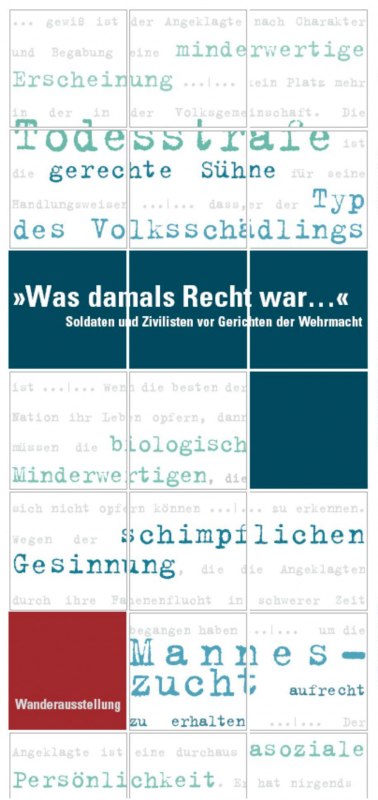
The exhibition "What was right then...", which now - more than eight decades after the end of the Second World War - provides information about the injustice and arbitrariness of Nazi military justice, is a project of the Foundation Memorial to the Murdered Jews of Europe. It is funded by the Federal Government Commissioner for Culture and the Media and was created in cooperation with the Federal Association of Victims of Nazi Military Justice, the Federal Agency for Civic Education, the German Resistance Memorial, the Saxon Memorials Foundation and the Saxony-Anhalt Memorials Foundation/ROTER OCHSE Halle (Saale) Memorial.