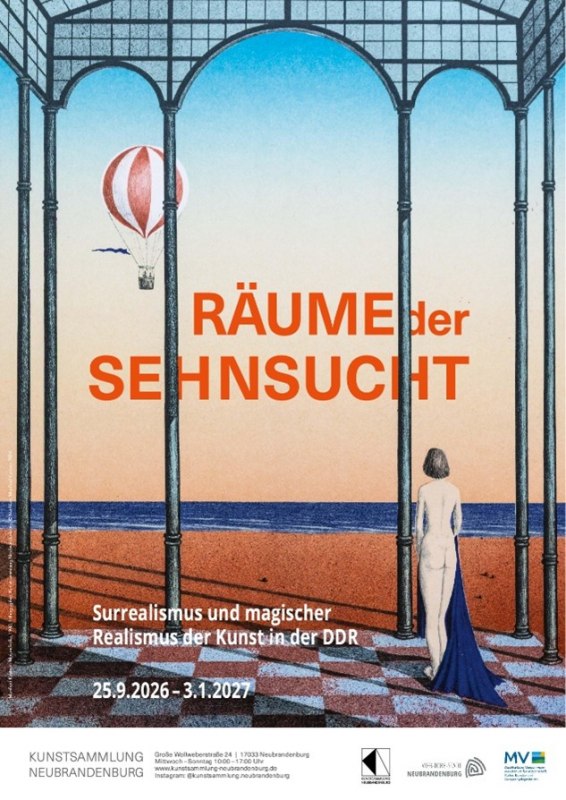
“Spaces of Longing” showcases the surrealist and magical visual poetry of art in the GDR—an artistic utopia beyond political and aesthetic constraints.
Roger Garaudy, a professor of philosophy and member of the French Communist Party, once called for “boundless realism” (1963) and greater aesthetic freedom within Marxist art theory. His approach broke with the paradigms of partisanship, connection to the people, and accessibility—which many artists in the GDR and Eastern Europe had until then perceived as dogmatic. His open conception of realism, however, conflicted with socialist cultural policy, which rejected Garaudy’s ideas as bourgeois revisionism. Nevertheless, his ideas had an impact, particularly in the GDR, and enabled artists to create pictorial spaces through which they simultaneously and subtly undermined the political and aesthetic dictates of Socialist Realism.
The exhibition “Spaces of Longing,” featuring approximately 50 loaned works and pieces from the Neubrandenburg Art Collection, shows how this freedom is reflected in the artworks of the GDR: Artists experimented with the spatial constructions of Pittura Metafisica, with magical scenes that unfold before the viewer like dream worlds, all the way to grotesque landscapes and figures reminiscent of medieval depictions of demons. In narrative, mythical compositions, enigmatic beings and poetic worlds appear, further developing—and at times transcending or abstracting—European Surrealism. Labyrinthine, tumbling spaces detach the images from reality and open up utopias. Architectures appear stage-like, scenes like staged plays. The human figure appears as a visionary, transforming, merging with the bizarre environment, or attempting to escape it. The works serve no political or social purpose but rather form an artistic refuge in an alternate reality.
Magical realism and surrealism allowed artists in the GDR to develop a visual poetics beyond thematic or formal constraints, in which hope, doubt, resistance, and resignation became the central themes of visual worlds that, moving beyond conformist depictions of reality, dwell in the realm of the magical—and have lost none of their fascination to this day.