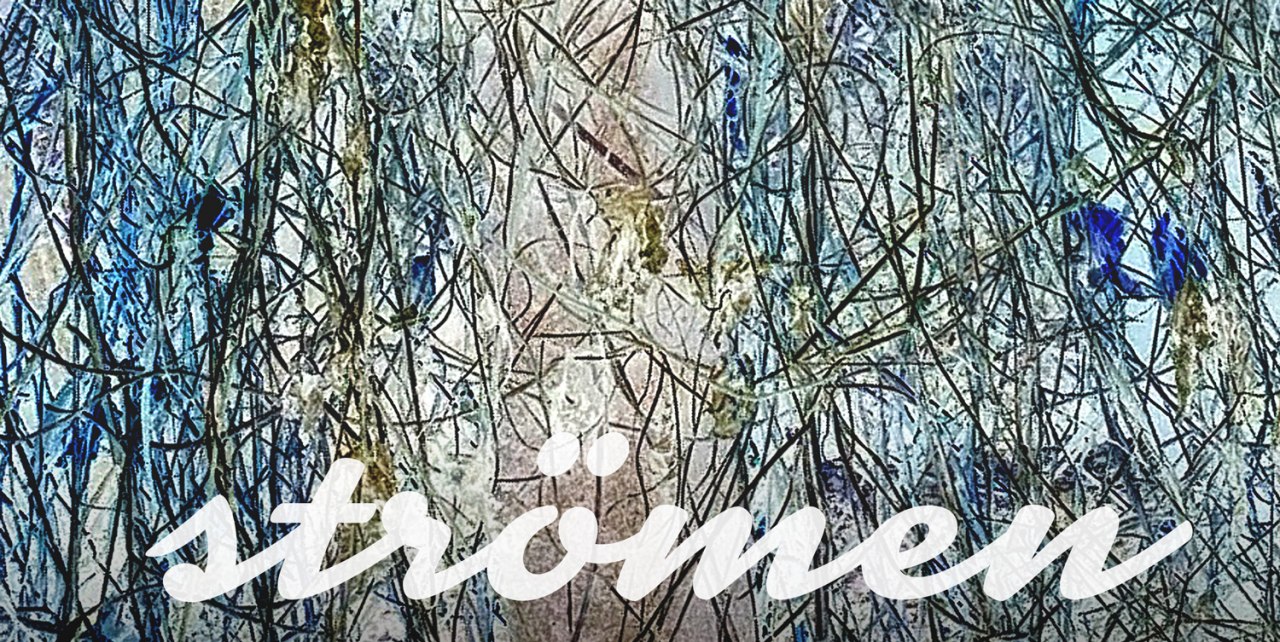
Three installation artists from Mecklenburg-Vorpommern are exhibiting together at the Kunstwasserwerk in Schwerin.
In the final exhibition of the year, Monika Ortmann, Mirjam Elburn, and Ramona Seyfarth come together at Kunst-Wasser-Werk e. V. for a visible dialogue—with the site, its architecture, its history, and with one another.
The spaces of the main building and pump house on the grounds of the Old Waterworks in Neumühle, which hold significant industrial-historical value, are far more than just a backdrop for the three installation artists: they are active participants in the dialogue, whose architectural and historical presence challenges the artistic exploration. It comes as no surprise that the title “strömen” (flow) was an obvious choice for this site, which once served as Schwerin’s water supply.
Water flows. Thoughts, air, and feelings stream. Words burst forth, information rushes through networks, emotions overflow. The three artists—all of whom live and work in Mecklenburg-Vorpommern—explore both the visible and the invisible: the flowing, seeping, and overflowing—physically and symbolically—each from her own perspective.
The Artists
Monika Ortmann, born in Bochum, studied art, visual communication, and photography in Berlin and Dortmund. Early travels to the Orient shaped her work just as much as later invitations to Cuba, Chile, Argentina, Korea, and Poland—including the 8th and 9th Havana Biennales. From 1979 to 2002, she founded and directed the K.L.E.C.K.S. Gallery in Herne. Since the beginning of her artistic career in the early 1970s, she has worked with found, used, and discarded materials: fabrics, pantyhose, shoes, dolls, waste paper—the flotsam of our society. Everything is spun, woven, and knotted into the “General Entanglements,” a walk-in image of our world. Her installations radically occupy the space. Ortmann lives and works in Wittenhagen, Bochum, and Berlin.
Mirjam Elburn, born in Siegen in 1976, studied art history and fine arts in Saarbrücken. She works as an artist and freelance curator at the intersection of analog and digital—using sculpture, installation, photography, and mixed media. Integrative and interdisciplinary art education is her central focus: In workshops and exhibitions, she creates spaces where experimental work and dialogue about art come together. The process-oriented, open nature of artistic creation is always at the center of her work.
Ramona Seyfarth, born in Neubrandenburg in 1980, has been living and working in her hometown again since 2013. Time is the central theme of her work—condensed, questioned, and made visible. In addition, she turns her attention to social structures and contradictions: flight, lost homeland, dignity. Through abstract symbols and works that are often fleeting and sensuous, she takes a political stand. In 2016, she received the First Art Prize for Emerging Artists in Mecklenburg-Vorpommern, and in 2021, the First Upcycling Art Prize at the Center for Circular Art in Lübz—for an installation made from shredded advertising brochures that were transformed into colorful Persian rugs.
In addition, please feel free to arrange a personal appointment by calling the cell phone number listed on the flyer.
If you happen to find yourself at the Alte Wasserwerk, please ring the bell at the main building.
Supported by the State capital Schwerin and the Ministry of Economy, Culture, and Federal Affairs of Mecklenburg-Western Pomerania