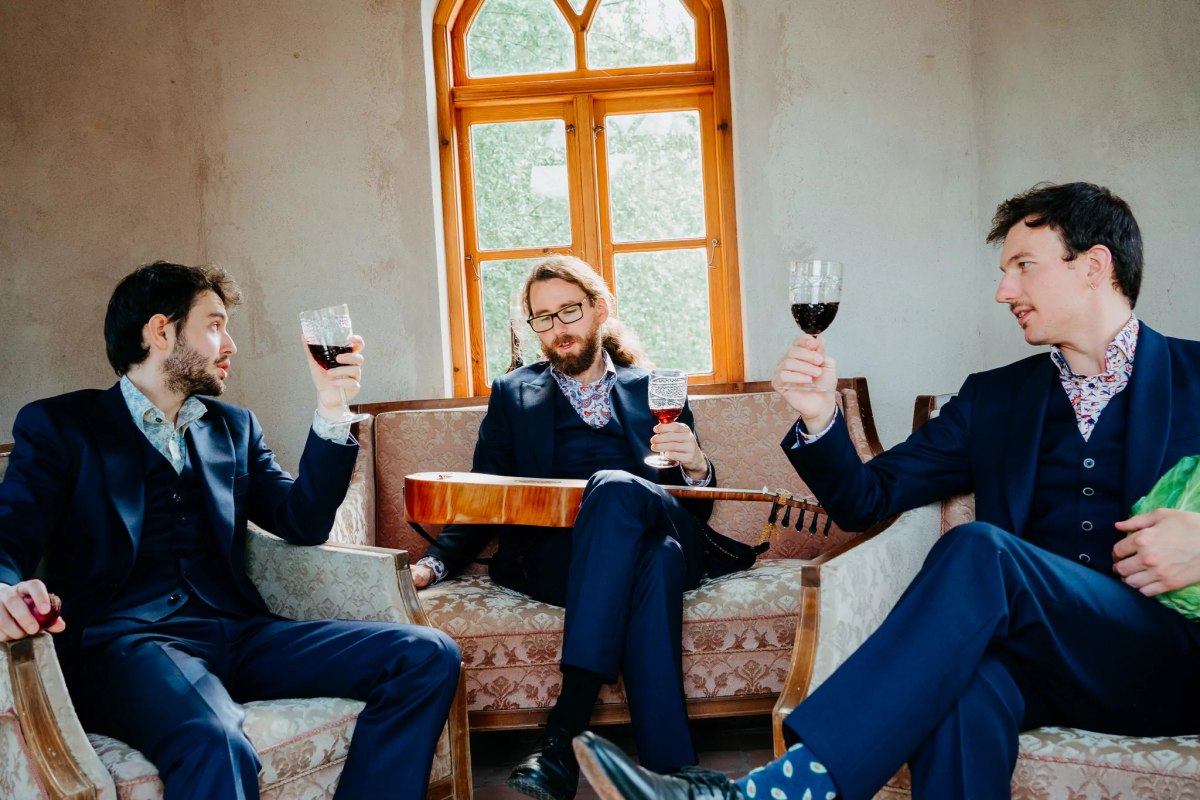
The "Due sopra il Basso" ensemble presents the program “Cristall Floods” – Early Baroque music for soprano, baritone, and lute
Above the bass:
Johannes Wieners – Countertenor
Jonathan Boudevin – Baritone
Max Hattwich – Renaissance lute & theorbo
A crystal flood of tears, the distilled quintessence of the heart, consumed by the flame.
The physical state of our grief—of human grief—has always been the salty, thick water that flows from our eyes. Our tears can be thick and hot, restrained and shallow, or sincere and clear as a mountain stream. In every conceivable form, they serve as an outlet for our pain (whether the pain that burns directly or that nostalgic sorrow which distinguishes the joy of tears of joy from a mere smiling joy), which usually breaks through our composed resistance and clears the way for what lies beneath—that which cannot find its way outward through words—to reach the outside world. This directly links the tear to the musical gesture, which likewise expresses the inexpressible and is connected to our inner life in a more penetrating way than words can. In Baroque music, the gesture of the sigh was explored to the point of exhaustion. Whether in France, Italy, England, or Germany, everywhere not only are tears (les larmes, le lacrime, the tears, die Thränen) sung about, but the tears themselves become music. In countless poetic images, they become rushing streams, burning arrows, crystalline drops, or even icicles, thus reflecting the immense richness of our painful or even painfully beautiful emotions.
In their current program, “Crystal Floods,” Due sopra il Basso devote themselves entirely to this phenomenon and explore the most diverse nuances of tears of sorrow in early Baroque music.
The program features French, Italian, and English pieces by Étienne Moulinié, Marc-Antoine Charpentier, Bartolomeo Tromboncino, Giovanni Girolamo Kapsperger, Andreas Hammerschmidt, John Dowland, Henry Purcell, and others.
This creates a water-rich kaleidoscope that, while centering on laments and weeping, is by no means limited to them. It ranges from poetic descriptions of nature—from fresh Arcadian springs and flower-covered wells to the cold infinity of the sea, which brings joy and even more sorrow to seafarers—all the way to the water poisoned by Bacchus, which seafarers do not use alone, to drown their sorrows in it.
The blue element is the fabric of this musical evening, which we begin in Arcadian lands and which leads us, shedding tears, across the rivers to the sea, so that we may finally seal it in the tavern.