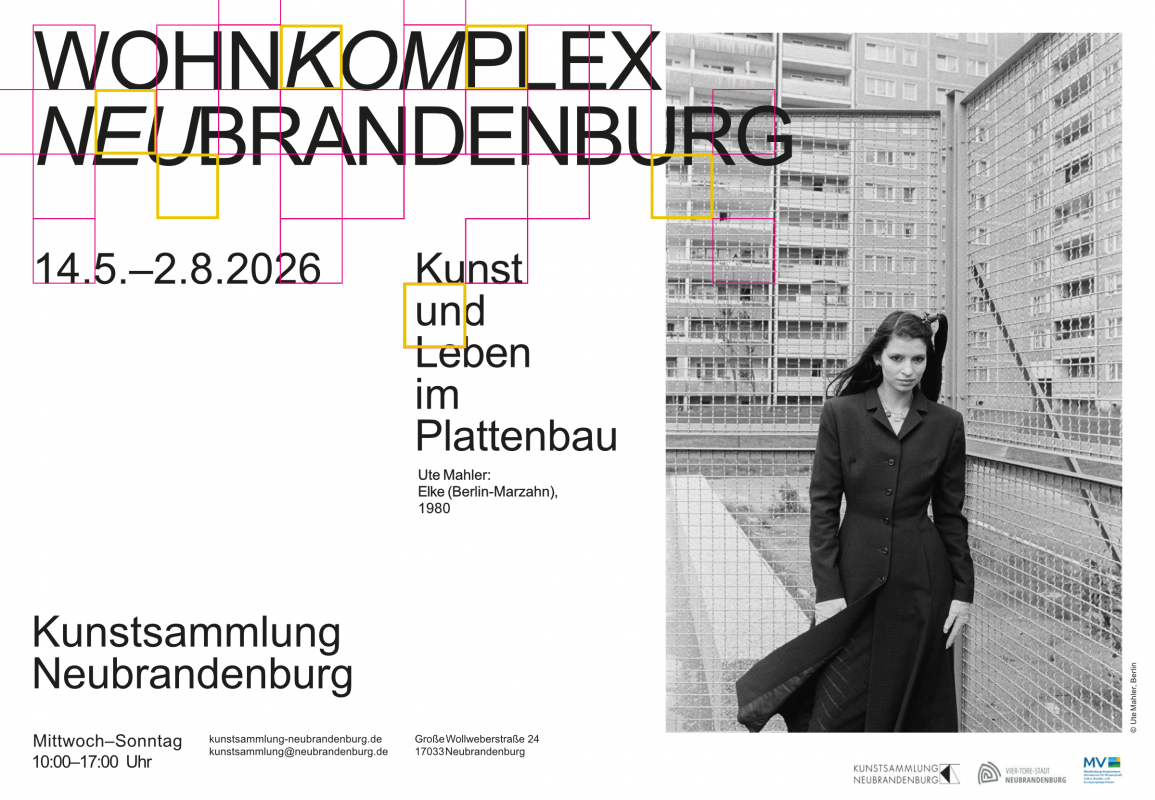
The exhibition Wohnkomplex uses contemporary art to show how prefabricated housing still shapes our society and urban landscape today.
The exhibition "Wohnkomplex - Neubrandenburg. Art and Life in Prefabricated Housing" is dedicated to a model of architecture and life that characterizes the four-gate city like no other in Germany: prefabricated housing.
The exhibition uses contemporary art and art in the GDR to show how this type of housing and building still has an impact on the urban landscape and society today. Against the backdrop of the rampant housing shortage in Germany, the exhibition and its accompanying program also provide references to one of the great socio-political challenges of the present.
Prefabricated housing was once at the heart of GDR social policy - a place of socialization and a symbol of real socialist progress. In Neubrandenburg, this model manifested itself with a rather positive response until 1990. After the end of the GDR, the Plattenbau became the scene of painful transformations and social division. To this day, it is itself in a process of transformation between monumental value and the lived present - a contested place of remembrance where housing and life continue.
With "Wohnkomplex - Neubrandenburg", Kito Nedo, in collaboration with the Kunstsammlung Neubrandenburg, is expanding the exhibition concept he originally developed for the MINSK in Potsdam to include a (self-)critical examination of the site. Between finding a new identity and a culture of remembrance, the exhibition focuses on the experience and life in this special architecture. On display are loans and works from the Neubrandenburg Art Collection, which shed light on the change and continuity of a development in the contradictions of the transformation society in East Germany.
Kito Nedo was selected for the exhibition and accompanying publication "Wohnkomplex. Kunst und Leben im Plattenbau" for the MINSK, Potsdam, was awarded the Justus Bier Prize for Curators 2026.
Among others, works will be shown by: Karl-Heinz Adler, Sibylle Bergemann, Jan Brokof, Manfred Butzmann, Andreas Dress, Mirjam Elburn, Sebastian Jung, Harald Kirschner, Karsten Konrad, Ute Mahler, Wolfgang Mattheuer, Uwe Pfeifer, Inken Reinhart, Juli Schupa, Wenke Seemann, Robert Seidel, Volker Stelzmann, Christian Thoelke, Claus Weidensdorfer, Karlheinz Wenzel and Siegfried Wittenburg.