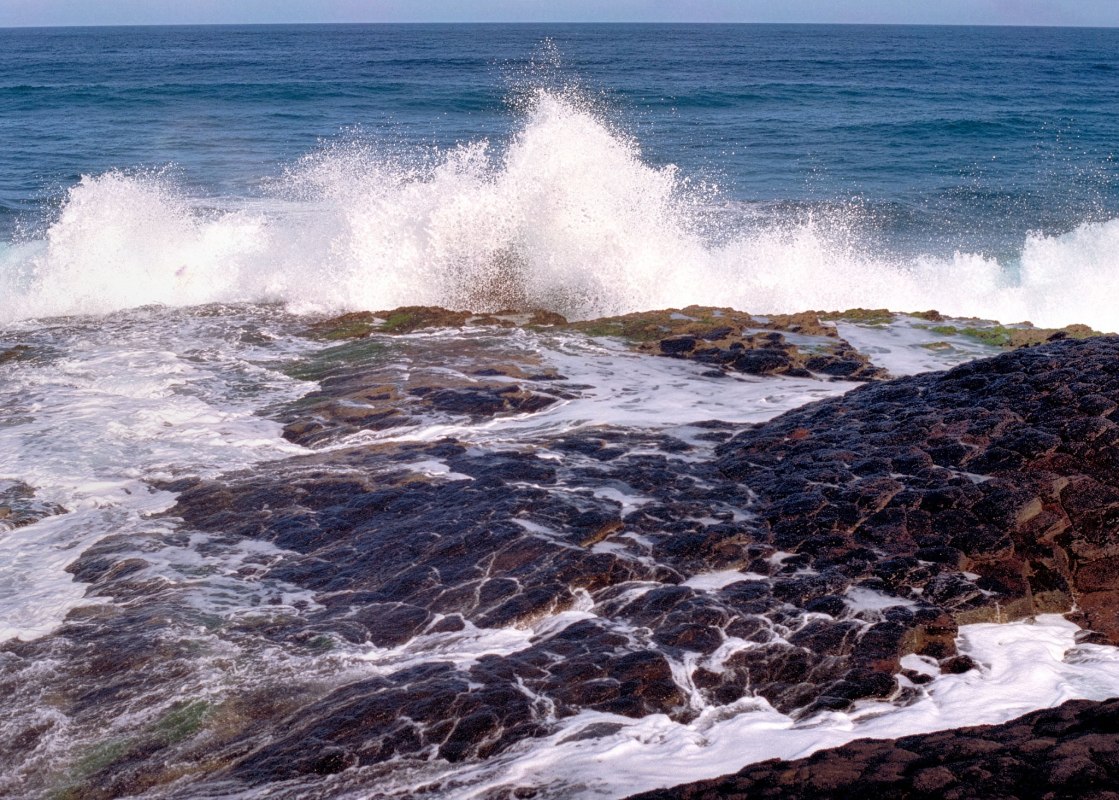
Exhibition in the foyer of the Mecklenburg-Vorpommern State Library: Günther Uecker
From August 31 to October 6, 2026, the State Library will offer insights into Günther Uecker’s views on nature. The exhibition will feature photographs, texts, and examples of the artist’s work. These pieces document his art actions, but also convey a sense of poetry and artistic aesthetics. The four elements—fire, water, earth, and air—serve as the common thread running through this multifaceted material.
“As a child on the Baltic Sea,” said Günther Uecker (1930–2025), “I saw sky and water, earth and fire.” Yet only one of his sculptural works engages with all four elements at once. As early as 1976, this cycle of horizontally positioned tableaux marked the beginning of the artist’s long journey of engagement with nature—a journey that began behind Rerik on the Wustrow Peninsula. The view of the Bay of Mecklenburg and the Salzhaff, the burning of dry grass for sheep grazing, and the furrows plowed through loamy soil were experiences for Uecker that made the elements of nature “naturally familiar to him, even on a grand scale.”
Later, Günther Uecker discovered unspoiled nature in Flanders and Arizona, in Appenzell, in the Libyan Desert, in Iceland, and on an “island in the Atlantic.” Combined with his childhood impressions, these places became for him sites of “free articulation.” The play of light, the perception of structure, spatial effects, and transience, the color white, and the departure from familiar dimensions characterize his view of nature. Early examples “apart from,” as he puts it, “the pluralistic world of imagination” include the actions “White Forest” (1965) and “Flemish Landscape” (1967, in collaboration with Jeff Verheyen). Shortly thereafter, Uecker participated in the first Land Art exhibition in the U.S. (1969). At the same time, he brought natural materials into the museum space; a legendary example of this, even to the present day, is his “Sand Spiral.”
From August 31 to October 6, 2026, the State Library will offer a glimpse into Uecker’s views on nature in its foyer. On display will be photographs, texts, and examples of his work. These not only document his art actions but also convey poetry through verses such as “Exposed to the Winds” (1998) or, through their aesthetics, evoke the essence of works like the print “Steppe Fire” (2008). The four elements—fire, water, earth, and air—serve as the common thread running through this multifaceted material
. Ancient natural philosophy traced all existence back to these four primordial elements. Even the vault of heaven was seen as surrounded by water. Since then, art has visualized this interpretation in a
formal language appropriate to
its
time. For the ZERO ideas of many postwar artists of the 1950s and 1960s, the return to these classical primordial elements also offered an opportunity to start anew from ZERO and leave behind the burdens of National Socialism. Günther Uecker drew on this concept early on and, together with Otto Piene and Heinz Mack, became one of the leading figures of the ZERO movement in Germany. This break with established ways of seeing and perceiving art corresponded to the general desire of the time for change and, thus, to the yearning for social renewal par excellence: ZERO found comparable movements across much of Europe.
Uecker’s art explored new materials and forms of expression, venturing into uncharted territory to bring art into life and to break with traditional views and bourgeois complacency. His work with natural materials and phenomena—often capturing the fleeting nature of a moment and the transience of a gesture—represents Uecker’s attempt to distance himself from the art market. Museums are meant to become “livable spaces.”
In many cases, the focus is on the artistic act itself, which leaves no lasting work behind. Short films and photography become suitable media for preserving Uecker’s actions. The State Library is exhibiting film stills from “Feuerblume,” “Schleifender Stein,” and “Schlagstein” (all circa 1986). Works such as “Fallgrube” (Barricade Construction) trace the student unrest of the ’68 movement. On display is a rare photographic document of “intermedia heidelberg” (1969). By transporting the object into the open natural world, Uecker creates, as he himself puts it, “aesthetic references directed toward the real world.”
Since the 1970s, travel has defined Günther Uecker’s relationship with nature. In “Spuren auslöschen,” he works with his own signature, as later film stills from 1986 also show. He drives nails into the sea (“Meeresplantage,” 1972) and into the desert as his signature, drawing furrows there just as he once did on farmland in Mecklenburg. Physically, he stages himself as part of nature, merging with it in his actions as a battered creature, as a faceless being, in order to make existential connections visible (“Entangled in Ropes,” 1986, or as “Sand Man,” 1970). Added to these, following the Chernobyl nuclear disaster, are the so-called “Ash Pictures
.”
More recently, Uecker has increasingly interpreted nature and its phenomena subjectively. Its wounds and their healing (the lithograph “Nagelbaum,” 2001, accompanied by the poem “Lichtung,” 1994) reflect the vulnerability of humanity. This long journey of artistic exploration culminates in 2024 with four tall arcs of light serving as windows in Schwerin Cathedral.
Uecker had returned to Wustrow, the place of his youth. Built on stilts, his studio hut stands there amid the beach grass. And when, on an artist’s poster (1991), the grass chirps like violins in the wind, and right across from it the motif “Cosmos” (2003) leads the exhibition visitor into the universe, may we recall the artist’s call: “Let us try to grasp the unimagined.”
Dr. Andreas Roloff
The exhibition “Between the Elements: Günther Uecker and Nature” runs from August 31 through October 6, 2026. Visits are possible during opening hours.
A short guided tour will be offered on September 9 and 30 at 1:00 p.m. each day. No advance registration is required. Admission is free.
The Mecklenburg-Vorpommern State Library Günther Uecker traces its origins to the Ducal Government Library, founded in 1779, and, as a critical infrastructure, preserves significant historical collections as well as a large collection of works from and about Mecklenburg-Vorpommern. The state of Mecklenburg-Vorpommern has legally mandated the State Library in Schwerin to collect, catalog, and archive the state’s current printed works for the future. According to state law and the ordinance on the deposit of printed works, all printed materials published in Mecklenburg-Vorpommern must be deposited with the State Library free of charge within one month of publication. The State Library acquires titles about Mecklenburg-Vorpommern that are published outside the state. The State Library is a department of the State Office for Culture and Historic Preservation. The historic building at its location on Johannes-Stelling-Straße is now part of the Schwerin UNESCO World Heritage Site.