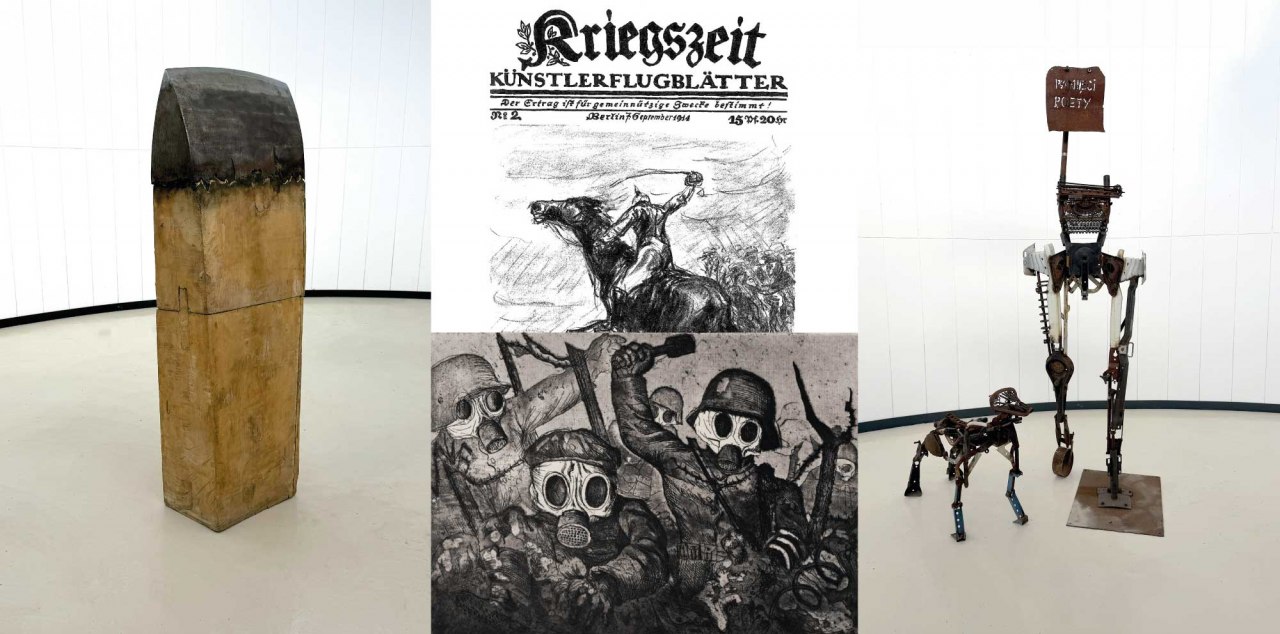
Sculptures by Polish artists and lithographs from the "war period" opposite etchings by Otto Dix
100 years after the First World War, the media and public opinion are dominated by defense and the ability to wage war. The FreshEggsGallery sends out a reminder. This exhibition in the cathedral offers many people a deeper insight into the past and space for reflection.
Curator Stephan Schrör juxtaposes the sculpture groups "The Seven Deadly Sins" (Adriana Majdzińska) and "Old Heroes with Companions" (Czesław Podleśny) with specific graphics from the time of the First World War.
Adriana Majdzińska
Sculptures: "The seven deadly sins"
Born in 1973 in Słupsk, Poland. A graduate of the Secondary School of Fine Arts in Koszalin, she completed her studies at the Academy of Fine Arts in Gdansk in 2000. In her artworks, she deals with classically understood spatial forms, working mainly in wood, but also using metal, stone, concrete or ceramics. The material she chooses is always subject to the content of the artwork. She manipulates simple, synthetic forms to which she assigns a symbolic value.
"Harmony between content and form in sculpture is the most important thing for me. I work to achieve this balance until the form becomes a symbol of the concept to which it refers."
Czesław Podleśny
Sculptures: "Old heroes with companions"
Born in Rybnik in 1959, son of a miner; sculptor, draughtsman, painter, poet. Student at Kenat High School/Zakopane, the Academy of Fine Arts in Gdansk and the Academy of Fine Arts in Warsaw. He has been presenting his works on the international art market for thirty-four years. Many solo exhibitions and over a hundred group exhibitions. In 2018 he graduated from the Academy of Fine Arts in Warsaw.
"The main theme of my work is the man. Supposed heroes live in the past, having fought for the wrong cause. Their medals contradict the current reality."
Wartime vs Otto Dix
Original lithographs from the weekly magazine "Kriegszeit", published from 1914 onwards, document the patriotic, euphoric enthusiasm for war at the time.
Glorifying militarism and trivializing the war, these prints show aggressive and blind patriotism.
Otto Dix's etching "The War" (1924) shows the completely opposite, experienced reality of a terrible war.
Dix experienced the First World War directly at the front. Between 1915 and 1918 alone, he created over 600 drawings in theaters of war in Belgium, France and Russia. They are an authentic documentation of trench warfare in the material battles of the First World War - an unmasking of the Moloch of war.