
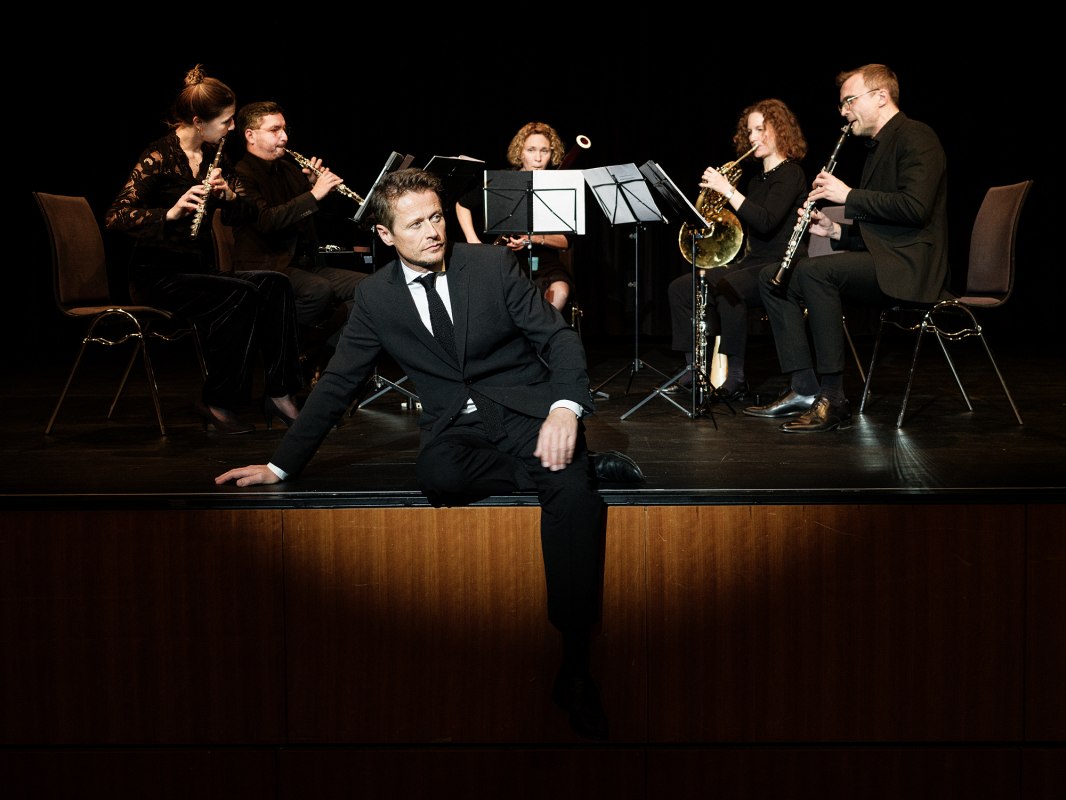
TV star Roman Knižka and OPUS 45 tell the story of the fall of the Weimar Republic—with a unique perspective on Neubrandenburg. Compelling, musical, and timely: How could Germany’s first democracy have failed? And what can we learn from it today?
How could a democracy crumble before everyone’s eyes? In “Germany, Can’t You See? – The Downfall of the Weimar Republic (1929–1933),” the final years of Germany’s first democracy. The program, which was awarded the Hans Frankenthal Prize by the Auschwitz Committee Foundation, takes a special look at Neubrandenburg.
In Neubrandenburg in particular, it becomes palpable just how rapidly the political situation changed: the first SA storm trooper unit in Mecklenburg-Strelitz was formed here. Beginning in 1931, the NSDAP, with eight seats, was the strongest faction in the city council. Following the Reichstag fire, on March 1 and 2, 1933, the homes of members of the KPD and SPD were also searched in Neubrandenburg; several communists were placed in “protective custody.” In the Reichstag election a few days later, the NSDAP received 4,530 votes in the city, while the SPD received 2,345.
Roman Knižka brings the voices of that era to life with texts by Erich Kästner, Mascha Kaléko, Kurt Tucholsky, Victor Klemperer, Sebastian Haffner, and Dorothy Thompson. The program also features music by Hanns Eisler, Kurt Weill, Erwin Schulhoff, Paul Juon, Jean Françaix, Cole Porter, and the Comedian Harmonists.
Literature, music, and contemporary history come together to address a highly relevant question: How could Germany’s first democracy have failed—and what can we learn from it today?
Sunday, September 6, 2026, 6:00 p.m., Konzertkirche Neubrandenburg. Free admission. Sponsored by the State Agency for Political Education of Mecklenburg-Vorpommern.