An opera in three acts by Giuseppe Verdi / Libretto by Francesco Maria Piave / Based on the play “Le roi s’amuse” by Victor Hugo In Italian with
This opera contains what is perhaps the most famous tenor aria in the world: “La donna e mobile.” In it, the Duke of Mantua proclaims his frivolous, cynical view of women to the world—catchy, brilliant, and at the same time shockingly superficial.
Giuseppe Verdi, however, saw far more in Victor Hugo’s play *Le roi s’amuse* than just this dazzling character: the material is magnificent, powerful, and it contains a role that is one of the greatest creations of which the theater of all countries and all ages boasts. He was referring to the character of the court jester Rigoletto, who gave the opera its name. As a court jester, he shields himself with scorn and cynicism, makes himself an accomplice to his master, and even helps with the latter’s unscrupulous love affairs. For the nobleman knows no morality; he takes whatever he wants.
But what happens when the Duke first sees Gilda, Rigoletto’s daughter, whom he anxiously tries to protect from that corruption? Suddenly, the game played by the court jester—mentally and physically stunted—becomes a struggle for life and death…
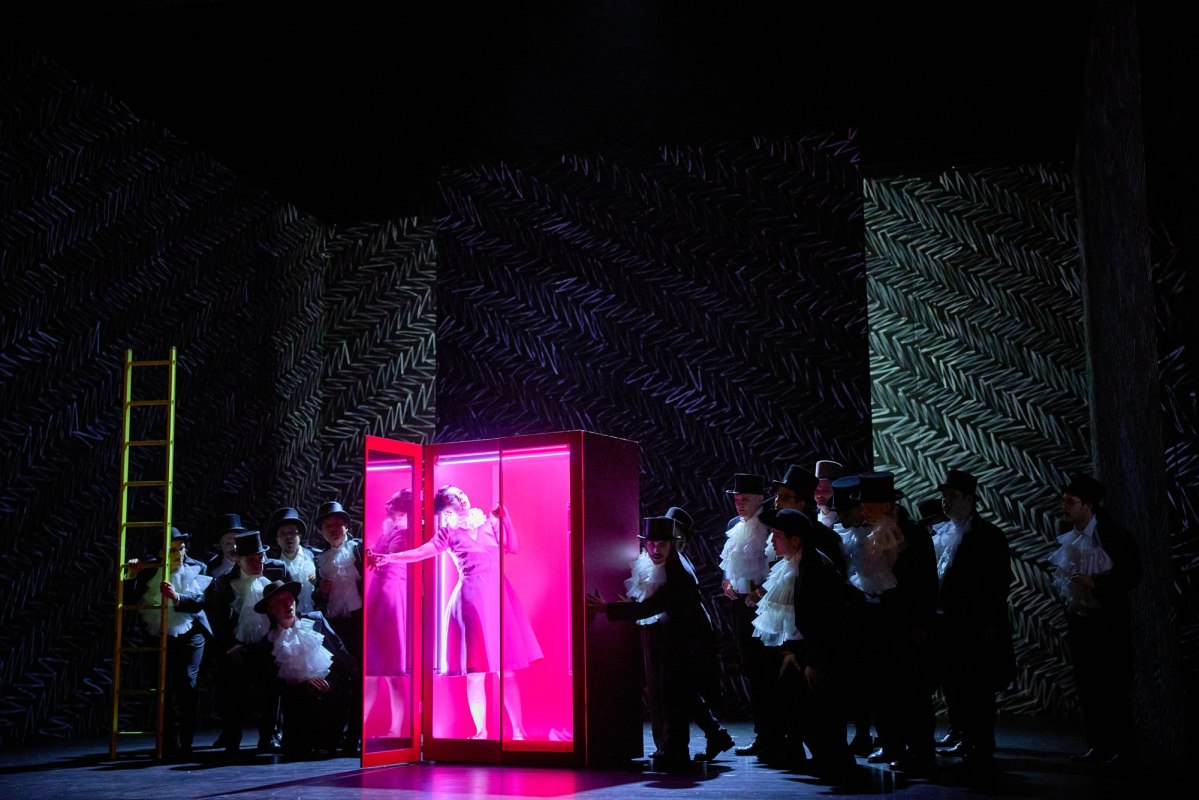
Director Christian Poewe and set designer Wiebke Horn, who brought the acclaimed production of *Tosca* to the stage of the Volkstheater, return to Rostock for the Musiktheater’s season opener.
Note on the Production’s Content
Ukrainian soprano Alina Tkachuk can be seen in the role of Gilda. In an interview, she talks about her path to opera, her fascination with this role, and what interests her offstage.
Celebrated that evening was a tragedy that remains heart-wrenching, full of intense emotions and passions. Celebrated was a compelling ensemble featuring a lively male chorus. The bravos were directed at baritone Rolfe Dauz for his emotional power in the title role, as well as to soprano Alina Tkachuk as Rigoletto’s daughter Gilda for the virtuosic vocal lightness with which she portrayed her naivety and, later, the poignant tone of her despair. (Dietrich Pätzold, Baltic Sea Times)
Rolfe Dauz [took on] the premiere role of Rigoletto and overwhelmed the audience: Repeated cries of “Brava, Brava” acknowledged his successful portrayal of the deeply tormented jester. [...] Alina Tkachuk lends Gilda definition with her clear interpretation and also manages to give voice to the heart-wrenching transformation of the defiled daughter in the second part of the evening. Her singing, too, was honored with “Brava” shouts from the audience. ( Maria Häfer, Nordkurier)