
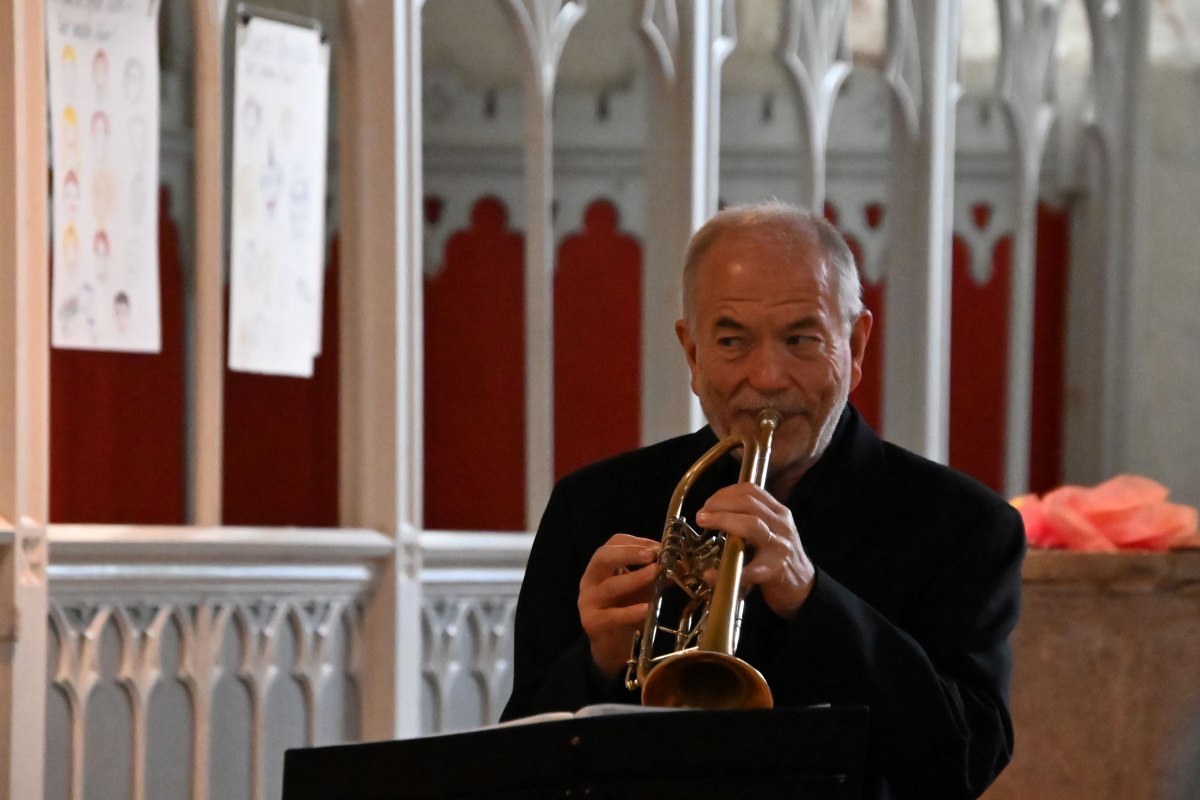
Historian Christoph Wunnicke tells this story by tracing major historical trends and recounting vivid anecdotes. Between the individual stories, musical pieces for trumpet, organ, and flute are performed by organist Reinhard Kotitschke, trumpeter Ulf Rust, and flutist Cordula Rust.
Hardly any other instrument can sound as festive, solemn, and at the same time piercing as the trumpet.
The history of the trumpet in Mecklenburg goes back a long way. Among the oldest wind instruments ever found are the approximately 3,400-year-old “Wismar Horn” and the Bronze Age lurs discovered near Daberkow in 1911. Since the Middle Ages, trumpets have served as a symbol of noble power. At the courts in Schwerin, Güstrow, Ludwigslust, and Neustrelitz, trumpeters summoned the court to the table, accompanied weddings and funeral processions, and lent splendor to the dukes’ appearances. In Güstrow and Schwerin, there were even dedicated trumpeter’s chairs.
But the trumpet was not heard only at court. Town pipers and watchtower keepers used it to signal the hours, issue warnings, and report fires. Town musicians played at civilian weddings, postilions announced the arrival of the stagecoach, and military trumpeters accompanied soldiers during drills and into battle. In churches, trumpets resounded alongside organs and choirs. Later, trombone choirs, brass bands, and large factory orchestras shaped the musical life of Mecklenburg.
Historian Christoph Wunnicke recounts this history through major historical trends and vivid anecdotes. Between the individual stories, musical pieces for trumpet, organ, and flute are performed by organist Reinhard Kotitschke, trumpeter Ulf Rust, and flutist Cordula Rust.
After the final note, one realizes: The trumpet was never just a musical instrument. It was a signal, a symbol of authority, a companion in war and peace—a voice of Mecklenburg that could be heard from afar.
Admission is free; donations are welcome.