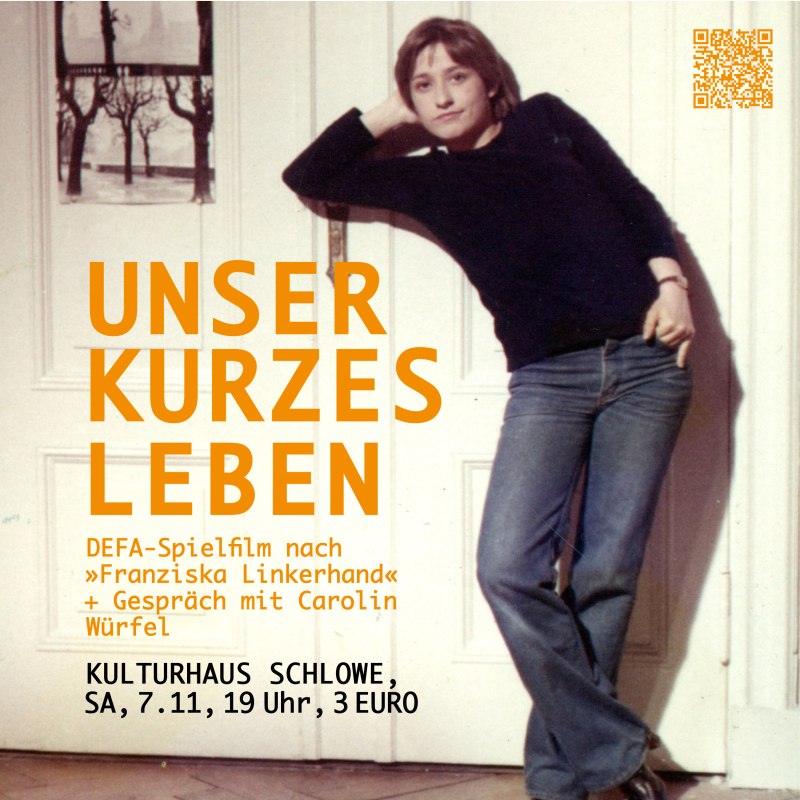
DEFA feature film (1981) based on “Franziska Linkerhand” + discussion on the state of women’s emancipation in the GDR and the FRG in the 1980s
GDR 1981 *
* Director: Lothar Warneke
Screenplay: Regine Kühn and Lothar Warneke, based on the novel *Franziska Linkerhand* by Brigitte Reimann
Cast: Simone Frost, Gottfried Richter, Dietrich Körner, Christian Steyer, Barbara Dittus, Hermann Beyer, Christine Schorn
Franziska Linkerhand is a young architect with high standards—not only for herself but also for socialist urban planning. She expects more from urban planning than simply meeting quotas by building as many apartments as possible. Newly developed neighborhoods should not merely be “dormitory towns,” but rather offer residents an attractive living environment through their architectural design and amenities, thereby bringing socialism to life. Franziska decides to leave the academic world of Dresden and play an active role in shaping the countryside. Her supervisor, however, is not at all enthusiastic about her extravagant ideas and reacts to Franziska’s zeal for reform with vigorous resistance.
The fact that she is ultimately able to get her way time and again is not primarily because she is valued as a person or for her professional expertise, but rather because of her youthful charm. It seems that while the young woman has learned to use this to her advantage, she is at the same time more adrift than in control in a rough, often violent male-dominated world—both in her personal and professional life.
Following up on a discussion that began in May of this year with the author of the book “Three Women Dreamed of Socialism” and the audience in May of this year regarding the state of women’s emancipation in the GDR and the FRG, we were able to secure Carolin Würfel to contextualize the film and the unfinished novel by Brigitte Reimann that inspired it from both an East German and a feminist perspective.
This event is taking place in cooperation with and with the kind support of the Rosa Luxemburg Foundation M-V.
As always, the café opens at 6 p.m. and remains open for post-event discussions. Admission is 3 euros.