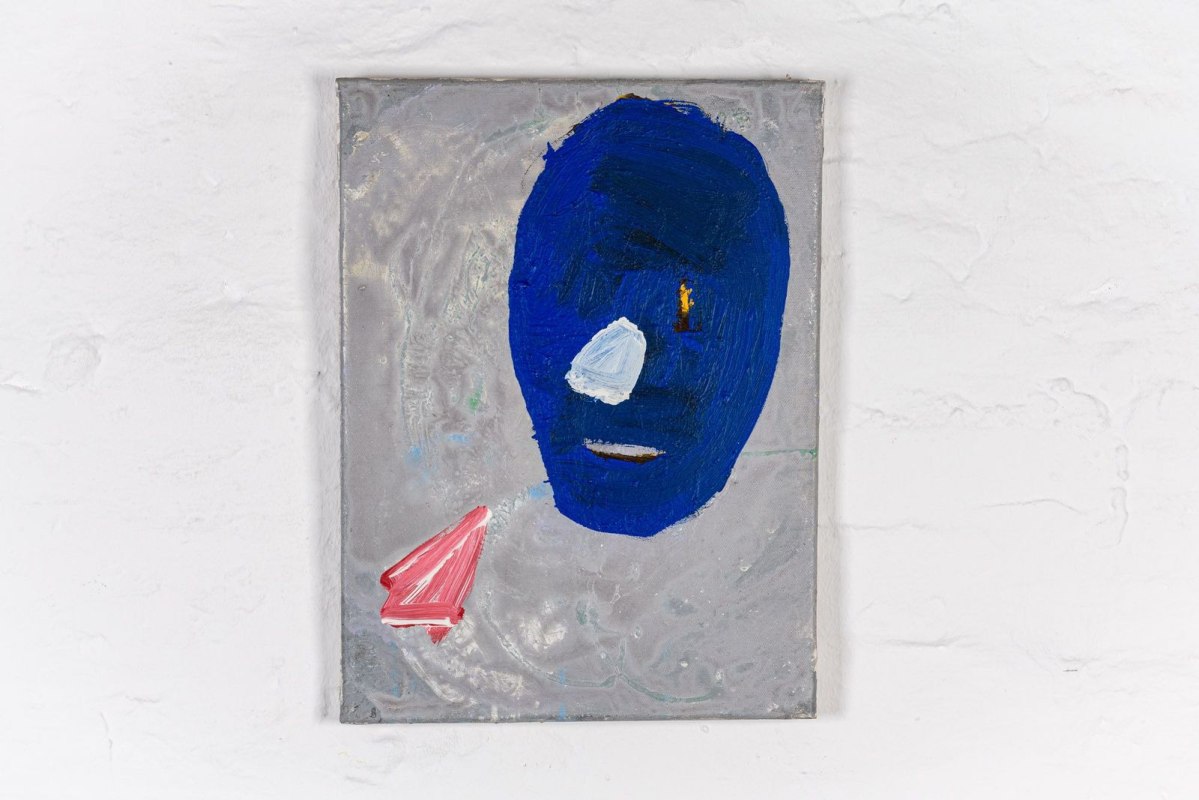
Abstract paintings by Jørgen Dobloug, who, more than any other Nordic artist, was closely associated with the German avant-garde scene of the 1970s.
Jørgen Dobloug (1945–2018), bornin Oslo, was a Norwegian painter whose artistic development was closely linked to the Düsseldorf avant-garde of the 1970s and 1980s. From 1971 to 1984, he studied at the Düsseldorf Art Academy, was accepted into Joseph Beuys’s class, and eventually became one of his master students. Dobloug’s artistic career was decisively shaped by his encounter with Beuys’s art during the artist’s exhibitions in Basel in 1969. His painting style evolved into an open, ongoing process, balancing control and spontaneity, geometry and free expression. Dobloug worked primarily with oil and acrylic paints, creating vividly colored, emotionally charged paintings. His range extended from strictly geometric hard-edge paintings and grid structures to playful, free pictorial compositions. In his body of work, geometric forms and organic lines combine to form abstract compositions as well as more or less recognizable faces, masks, and figures.
Beuys was an important artistic reference point for Dobloug, particularly through their personal exchanges about art and their exploration of painting and its technical processes. After Beuys left the art academy in 1978, Dobloug continued his studies with Daniel Hees and Franz Eggenschwiler and remained closely connected to Düsseldorf’s vibrant art scene until the turn of the millennium. In 1976, he received a fellowship for the Cité Internationale des Arts in Paris. From the 1990s onward, he lived primarily in Oslo, though the artistic techniques he developed in Düsseldorf continued to shape his work. For decades, his paintings have been represented in many major art collections throughout Germany and Norway.
Featuring a selection of portraits and landscapes, the exhibition at the Edvard Munch House in Warnemünde offers a rare glimpse into Dobloug’s extensive and multifaceted body of work. The works illustrate Dobloug’s expressive visual language, in which abstraction and figuration, order and disorder, and intense colors engage in a profound dialogue.
We would like to express our sincere thanks for the support provided by:
Hanseatic and University City of Rostock
Mecklenburg-Vorpommern, Ministry of Science, Culture, Federal, and European Affairs